Posts

Showing posts with the label Norse Folklore

why it's called a Kelpie.

Image
In Northern folklore, the water horse attracts, adheres, and drowns those who touch it, but it's never adequately explained why it's called a kelpie.  While it's not for certain, it's thought the Scots word's related to the Gaelic "calpa"  or colt, but one might instead guess it has to do with kelp. In the latter line of thinking,  God Of War: Ragnarok  shows the kelpie with a tail made from strands of kelp, and when it transforms to dive underwater, even more kelp-constructed fins emerge from its body! This visual explanation's a seriously good example of NorsePlay as it helps fill-in an obvious answer that may have never previously presented itself. Yet even if this is an etymological coincidence, it shows how some myths become even more adorned as they roll forward in time by  gathering the moss of artistic decision  ... or in this instance, gathers kelp. Safety warning: Do not be fooled by this GoW:R video -- do not touch ...

the implications of Norse elements in fairy tales.

Image
Flipping through Andrew Lang's The Crimson Fairy Book (1903 CE), I read  a pretty brilliant NorsePlay  remix in the story of  The Horse Gullfaxi and the Sword Gunnföder . This story is full of loans & borrowings from across the lore, the large ones being the hero named Sigurd (from The Saga of the Volsungs ), the horse Gullfaxi (from the race in  Skáldskaparmál ) which one is forbidden to ride (this rule from  Hrafnkels saga applied to his horse Freyfaxi), and a weather effecting magic item that summons hail (from The Story of Thorstein Mansion-Might ). There are a couple other lesser parallels to be divined, but the above are the most certain & definitely present. [story illustration by Henry Justice Ford.] Even without being well-versed enough in the Norse Lore to identify any of the above, the story in itself stands alone as a fun tale. Sourcewise, Lang adapts the story from an 1884 CE German translation by Viennese politician & Scandinav...

corpsepaint is actually draugrpaint.

Image
Examine this NorsePlay with me: Black Metal's signature look is corpsepaint. Black Metal hails from Norway and, if we watch the documentaries about the subgenre's roots, has nothing to do with the press' sensationalistic misconstruals of Satanism, but with reconnecting to a Nordic pre-Christian past. The  often-malign  foraying corpses of Norse Lore are the Draugr. Since Black Metal bands & their followers' ritualistic near-necroshamanic painting practice at least partly stems from a willful feeling for a lost past, this mirrors the Draugr's protectiveness of its valued artifacts, and a postmortem renascence of ancient ideas from within the mound waiting to emerge once again. [photo from Daughters Of Darkness  book by Jeremy Saffer, Draugr logo from Hertfordshire, England band.] #    #    # Guillermo Maytorena IV knew there was something special in  the Norse Lore when he picked up a copy of the d'Aulaires'  Norse...

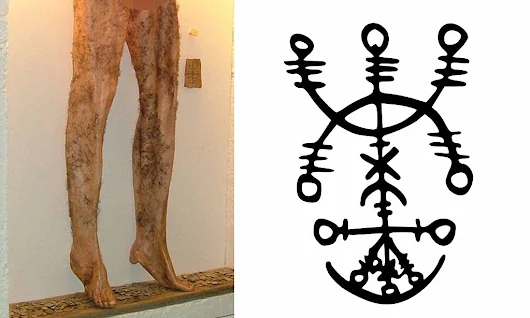
time to put on your big boy Necropants ... or not.

Image
Icelandic lore has it that if you get permission to take a man's skin from the waist down, rob a poor widow of a coin, then place the coin in the pants' sack with a magical stave on paper, it will generate an endless supply of money! This item, the Nábrók, roughly translates to "Necropants". [Housed at the Museum of Icelandic Sorcery & Witchcraft, and credit to its manager Sigurdur Atlason for this morbidly fascinating share!] #    #    # Guillermo Maytorena IV knew there was something special in  the Norse Lore when he picked up a copy of the d'Aulaires'  Norse Gods and Giants  at age seven. Since t hen he's been fascinated by the truthful potency of Norse Mythology, passionately read & studied, embraced Ásatrú, launched the  Map of Midgard  project, and spearheaded the neologism/brand NorsePlay.   If you have e mployment/ opportunities in  investigative mythology,  field research, or product...

Icelandic ogress Grýla eats your babies.

Image
Icelandic ogress Grýla by Þrándur Þórarinsson (2009). She only eats bad children, which could be seen as providing a service, in its own grim way. [Þrándur Þórarinsson, Gryla , 2009.] "Grýla is a mythical giantess living in the mountains of Iceland. Most of the stories told about Gryla were to frighten bad children, and her name is mentioned in Snorri Sturluson's thirteenth century Edda. Grýla was not directly linked to Christmas until the 17th century. By that time she had become the mother of the Yule Lads. Terry Gunnell hypothesizes that the medieval custom of dressing as Grýla may be related to other visiting traditions such as Julebukk or the Yule Goat and that her name may mean 'threat' or 'threatening'. She has the ability to detect children who are misbehaving year-round. During Christmas time, she comes from the mountains to search nearby towns for her meal. She leaves her cave and hunts for the children. She devours children as her favori...