Posts

Showing posts with the label Snorri Sturluson

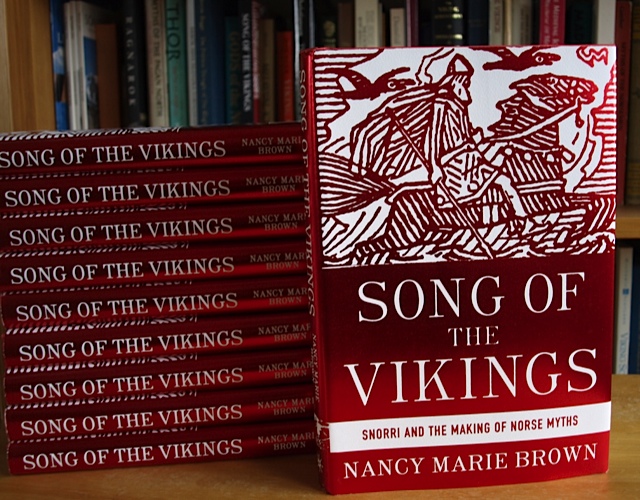
Book Review: "Song of the Vikings -- Snorri & the Making of the Norse Myths" and NorsePlay on the priceless "Prose Edda".
Image
Whether you're Ásatrú, Heathen, or a Norse Studies academic, t he important questions most of us who pick up Nancy Marie Brown's Song Of The Vikings: Snorri and the Making of Norse Myths  are actually looking for answers about are why Snorri Sturluson wrote the Prose Edda , how compromised by the conversion are its contents, and beyond those, is there a divine manifestation in its writing? Before we approach those answers, this 2012 CE work first uses sources & then extrapolations to determine who Snorri was. In terms of direct accounts, the  Sturlunga Saga  shows Snorri's role in the time directly before Iceland cedes its independence to Norway. Beyond this,  Brown's technique of assembling the character of Snorri is somewhat  of a deconstruction of his literary output. Brown infers that since Odin had certain pronounced qualities (i.e. wisdom, guile, leadership, ladies' man who fathers it up) that Snorri in turn had these qualities.  This line of thin...

the Edda was written by a Raven.

Image
During the early medieval period of Iceland, after the conversion brought with it a change from an oral tradition to written manuscripts , quills were made from goose, swan, and ravens' feathers. Quills were always selected from a left wing, since the feather would curve away from the right-handed writer so they wouldn't Odinically poke themselves in the eye , nor have the feather blocking their line of sight from themselves to the page. One could be poetic in saying that Huginn & Muninn had a pinion in the Prose Edda 's scripting , the memory of Snorri writing, and the thoughts of Snorri composing, onto the vellum pages. [Raven wing photo from the Slater Museum of Natural History Raven Quill Dip Pen made by Mariya Green aka Vrana Raven (Etsy: vranaraven.)] #    #    # Guillermo Maytorena IV knew there was something special in  the Norse Lore when he picked up a copy of the d'Aulaires'  Norse Gods and Giants  at age seven. Since t h...

possibly the crown of a Goddess.

Image
This is a lot of ifs: If the ancient tribe of Alans, also referred to as the As, are identifiable as the pre-migration Aesir as per Snorri's Heimskringla , this might be an euhemerized Goddess' crown given the extreme fineness of artistry in the cast gold. Note the stags eating off a possible Yggdrasil and the two possible ravens on the band. [Diadem made by the Sarmato-Alanian Culture, 1st century C.E.] #    #    # Guillermo Maytorena IV knew there was something special in  the Norse Lore when he picked up a copy of the d'Aulaires'  Norse Gods and Giants  at age seven. Since t hen he's been fascinated by the truthful potency of Norse Mythology, passionately read & studied, embraced Ásatrú, launched the  Map of Midgard  project, and spearheaded the neologism/brand NorsePlay.   If you have e mployment/ opportunities in  investigative mythology,  field research, or product development to offer,...

Icelandic ogress Grýla eats your babies.

Image
Icelandic ogress Grýla by Þrándur Þórarinsson (2009). She only eats bad children, which could be seen as providing a service, in its own grim way. [Þrándur Þórarinsson, Gryla , 2009.] "Grýla is a mythical giantess living in the mountains of Iceland. Most of the stories told about Gryla were to frighten bad children, and her name is mentioned in Snorri Sturluson's thirteenth century Edda. Grýla was not directly linked to Christmas until the 17th century. By that time she had become the mother of the Yule Lads. Terry Gunnell hypothesizes that the medieval custom of dressing as Grýla may be related to other visiting traditions such as Julebukk or the Yule Goat and that her name may mean 'threat' or 'threatening'. She has the ability to detect children who are misbehaving year-round. During Christmas time, she comes from the mountains to search nearby towns for her meal. She leaves her cave and hunts for the children. She devours children as her favori...

the possibility of a talking dog-king.

Image
We've given some more thought to Snorri & Saxo's shared account of Saurr the talking dog-king , and remembered the late internet sensation Mishka the talking Siberian husky . Could an exceptional dog with speech abilities have occupied the throne of a subject nation for three years? Could a similar husky have been imported from the Rus to Scandinavia? Or was the mentioned golden collar a magical item that imbued a dog with speech? If canid Fenrir could talk & reason, why not another? #    #    # Guillermo Maytorena IV knew there was something special in  the Norse Lore when he picked up a copy of the d'Aulaires'  Norse Gods and Giants  at age seven. Since t hen he's been fascinated by the truthful potency of Norse Mythology, passionately read & studied, embraced Ásatrú, launched the  Map of Midgard  project, and spearheaded the neologism/brand NorsePlay.   If you have e mployment/ opportunities in  inves...