Posts

Showing posts with the label book review

NorsePlay Reviews: Vei gladiates the Aesir & Jotnar.

Image
  A girl's body's discovered floating in the open sea by a Viking prince's ship. Barely alive, they spare some of their dwindling water for her, and when she comes to, her eyes open ... to reveal goat-like horizontal pupils! This is the hook for Vei , a two-volume graphic novel , originally a Swedish 12-issue limited series from 2012 CE, and it is a stunningly executed NorsePlay. Writer Sara Bergmark Elfgren & artist Karl Johnsson gift us a re-scripting of Norse Mythology that answers the very real question of why don't the Jotnar or the Aesir just make a pre-emptive attack now to get an early victory and not have to suffer the pyrrhic resolution of end-time Ragnarök? The answer is a détente struck by a longstanding "peace" agreement mediated by a periodic gladiatorial combat. The winning side then for that time gets the domain of contested Midgard, which makes our world & its mortal reverence the key to divine power! This gives us a sweeping story rev...
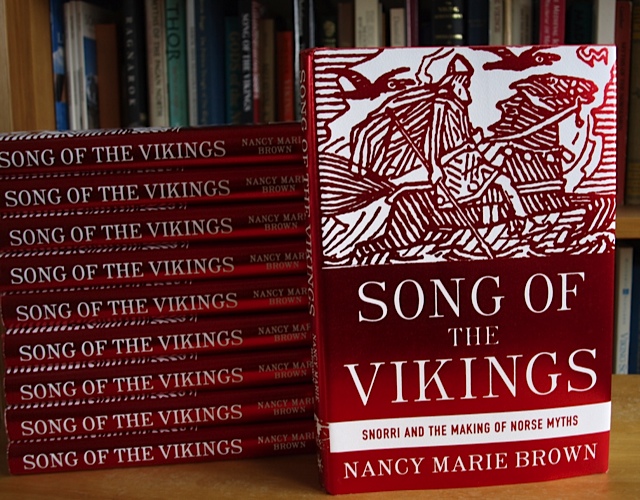
Book Review: "Song of the Vikings -- Snorri & the Making of the Norse Myths" and NorsePlay on the priceless "Prose Edda".

Image
Whether you're Ásatrú, Heathen, or a Norse Studies academic, t he important questions most of us who pick up Nancy Marie Brown's Song Of The Vikings: Snorri and the Making of Norse Myths  are actually looking for answers about are why Snorri Sturluson wrote the Prose Edda , how compromised by the conversion are its contents, and beyond those, is there a divine manifestation in its writing? Before we approach those answers, this 2012 CE work first uses sources & then extrapolations to determine who Snorri was. In terms of direct accounts, the  Sturlunga Saga  shows Snorri's role in the time directly before Iceland cedes its independence to Norway. Beyond this,  Brown's technique of assembling the character of Snorri is somewhat  of a deconstruction of his literary output. Brown infers that since Odin had certain pronounced qualities (i.e. wisdom, guile, leadership, ladies' man who fathers it up) that Snorri in turn had these qualities.  This line of thin...

NorsePlay considers the Last Rituals.

Image
We took a break from our long four-year reading-fest of comparative Norse Mythology & Norse Lore source materials to book club a ScandiNoir novel by Yrsa Sigurdardottir, Þriðja táknið (translated as The Third Symbol) , or re-titled for English audiences, Last Rituals . Given the goetic-looking runestave symbol and mention of witchcraft flaunted on the cover, we're promised spookiness from the get go, though given this is a first novel in an intended series, we spend a lot more than a goodly amount of time establishing our lead character's voice as a financially challenged divorcée mother-of-two's status as a l awyer-cum-detective . As a grown late-30s-something with what one would presume much criminal defense experience in what's arguably the most feminist country in the world, attorney Thóra Gudmundsdóttir's surprised reactions due to her underexposure to body modifications, BDSM, and other subculturally outré elements in the mystery comes off l...

A Yank At Valhalla.

Image
Not to let the  hokey Twain-ist title fool you, Edmond Hamilton's  A Yank at Valhalla  delivers  a Norse-inspired genre mash-up in fine pulp style. [Original pulp from January 1941.] Part lost civilization fantasy, part science fiction,  Hamilton plays with the idea that behind mythology lies a greater truth. Physicist Keith Masters, during an exploratory survey flight, gets blown into a hidden area of the arctic  where he discovers the secret lands of  the Norse Gods . [An Ace double version from 1973.] Stylewise, the many typos (a pulp given) are  unexpectedly balanced out by some lovely .50-cent word selections, and it's neat shifting gears as a  reader between scientific terms and medieval descriptors. This integrated juxtaposition aside, a lot of  the presentation is stirring with cries of "Our swords for Asgard!", impressive feasting hall settings, and  saga worthy melees & martial battles. [UK re-tit...

Neil Gaiman's "Norse Mythology".

Image
Neil Gaiman faced the daunting task to adapt the narrative holy of the holies, the ur-book stories, the most ancient tales known to man from which all other tales have since flowed from: Norse Mythology . As we told a childhood friend of Neil's last month, Neil is a fearless writer, that before Neil there wasn't a great movement in the fantasy genre to use the Gods as actual intimate first & close third-person protagonists. [Neil Gaiman being fearless!] We look back at his record for this daring talent with reading pleasure:  The Sandman  (his breakout World Fantasy Award-winning graphic novel series expanding the being of Greek deity Morpheus),  American Gods  (heavily featuring Gods from various pantheons), and  Odd & the Frost Giants  (a  NorsePlay  story for children of all ages). And now, in a tribute to pay back what originally inspired him, Gaiman offers us his version of  Norse Mythology . In his introduction, ...

Chasing Magnus through the Norse Lore.

Image
The unwritten criticism of young adult offerings (and it's not a genre, it's a  market ) is that none ever seem to pass the bar of its progenitor J.K. Rowling -- all else that follows Harry Potter's been derivative. Nor have they been able to strike such a grand balance between character & world-building as Rowling. That bar still remains unapproached by Rick Riordan's latest trilogy series launch,  Magnus Chase and the Gods of Asgard: The Sword of Summer , though you'd think with the richness of Norse Lore to draw from it might surpass the young wizard, but  Magnus  makes for a fun read. Much like Riordan's  Percy Jackson  series, our titular protagonist has a mystery daddy, is a  streetwise kid,   has an important prophecy at age 16 event to propel their plot, and much internal thought reactions of sophomoric adolescent "smartness" in their texts for the teen reader & young-at-heart to identify with. And our newly chosen hero & hi...

Lester Del Rey's "Day Of The Giants".

Image
Long out-of-print and originally published in a shorter version titled  When The World Tottered  in 1950, Lester Del Rey ambitiously tackles the Twilight of the Gods in his 128-page novella. Most authors take the easy way out by instead writing a story about nearly avoiding doomsday, but Del Rey rises to the challenge and gives the audience the lead-up and final battle ... but perhaps not just as prophesied.  A predecessor to Greg van Eekhout's  Norse Code , Del Rey delivered  Ragnarök  fifty years earlier in the genre. An inexplicably long winter strikes, vexing weathermen, and causing worldwide privation, the results of which start communal breakdown & vigilantism in Leif Svensen's small rural town. Only because of their ancestors' stories do Leif & his recently returned prodigal brother Lee even think to reference  Fimbulwinter, and when a mysterious hitchhiker also happens to mention the prophesied world-ending final winter, do the p...